What the Cyber Security and Resilience Bill means for your business - a breakdown of the UK's biggest cyber law update in years, and the practical steps SMEs and their IT suppliers should be taking now.
You might not have heard of the Cyber Security and Resilience Bill yet. Over the next year, there's a good chance you will.
It's the biggest change to UK cyber security law in almost a decade, and while it's aimed at a specific list of large, regulated organisations, the effects are already starting to ripple out to businesses of every size.
Here's what's actually going on.
The Bill updates the UK's existing cyber security rules (the Network and Information Systems Regulations from 2018) and brings them broadly into line with similar rules already in place across the EU.
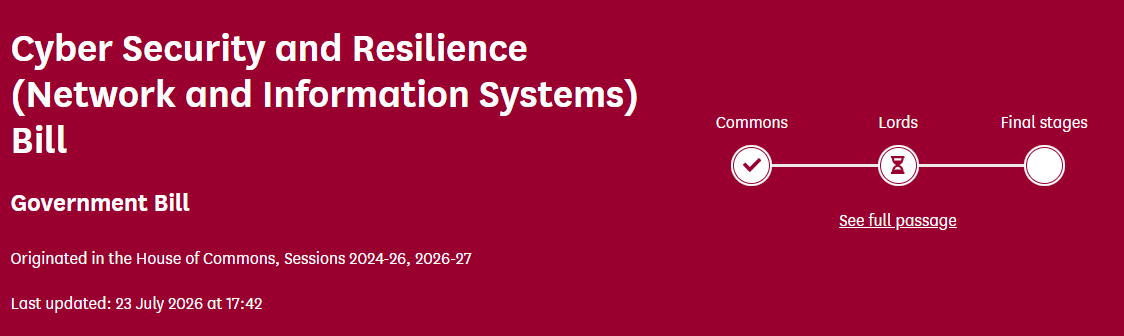
It was introduced to Parliament in November 2025, has already passed through the House of Commons, and is now being considered by the House of Lords. Royal Assent is expected later this year, with the rules then phased in gradually, likely stretching into 2027 and beyond for some of the more complex requirements.
If you're a business that supplies goods or services to a larger organisation, or if your IT is managed by an external provider, you're part of a supply chain that increasingly has to answer to this Bill even if you never deal with the regulator directly.
In practice, that's likely to show up as:
None of this requires waiting for the Bill to pass. The businesses that start preparing now will find the transition far less disruptive than those who wait for a client to ask a question they can't answer.
One of the more demanding requirements in the Bill is a tightened timeline for reporting cyber incidents: an initial notification within 24 hours, followed by a full report within 72 hours.
For a business without a dedicated security team monitoring things around the clock, that's a genuinely difficult window to hit (not because the rule is unreasonable, but because most SMEs simply don't have the visibility to spot an incident, understand what happened, and report it accurately within that timeframe.) This is exactly the kind of gap that we can help close.
The good news is that none of the sensible next steps here are wasted effort, even if it turns out your business is only indirectly affected:
The Cyber Security and Resilience Bill isn't really about a single piece of legislation landing on a single day. It's a shift in expectation from "prove you haven't been breached" to "prove you're prepared." That shift is already under way.
We work with businesses to figure out where the gaps are and what to prioritise first whether that's Cyber Essentials certification, building a straightforward incident response plan or something else entirely specific to your setup.
We'll give you a clear, honest picture of where you stand and what's actually worth doing next.
Get in touch with our team today to talk through what this means for your business.